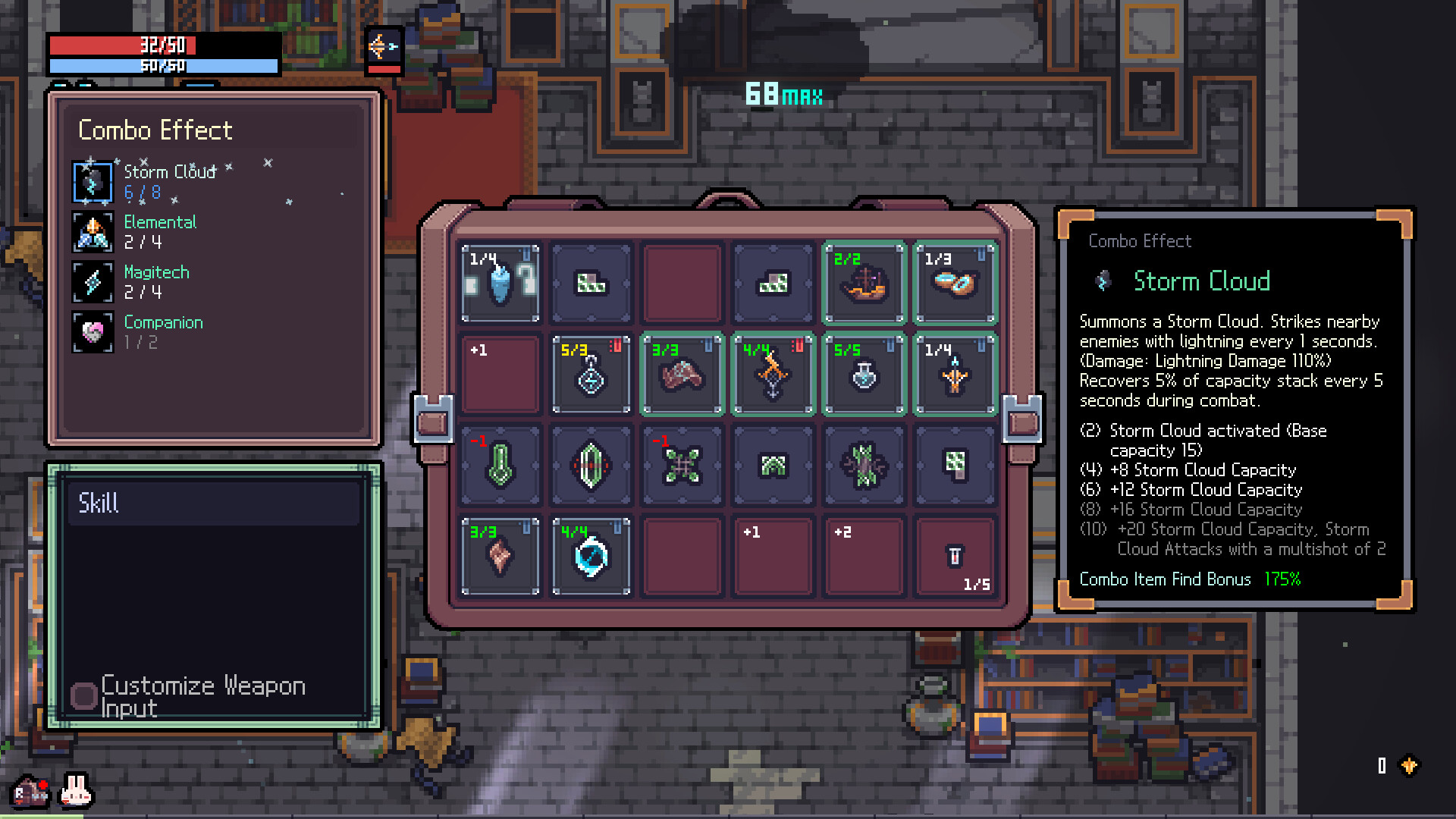
Official Sephiria weapon combat screenshot from Steam.
Official Steam media · TEAM HORAYThe six-branch model
Version 1.0 announces six weapon branches. Think of a branch as a combat identity: a way of pressing attacks that upgrades then deepen. The exact branch names are only published here when first-party strings are captured; the structural fact is the count of six and the upgrade pool size above two hundred.
Choosing a branch early reduces noise. Upgrades are more readable when they modify a single identity rather than a mash of half-learned kits. In co-op, different players can cover different branches so the party’s combined toolkit is wider without each player multitasking identities.
Blocking remains part of combat even when your branch is aggressive. Weapon page theory that ignores the block verb will fail in real rooms.
Six branches means six combat identities, not six fashion choices. Commit long enough to learn upgrade language for one identity. Exact branch names wait for first-party strings; the structural facts are the count of six and the upgrade pool above two hundred.
Reading the 200+ upgrade pool
“More than 200 upgrades” is launch-scale language for depth, not a promise that this wiki already lists each upgrade row. Use the number to set expectations: you will not master every upgrade in a single evening, and you should evaluate offers against your branch plan.
When an upgrade appears, ask three questions. Does it reinforce the attacks I already land? Does it reduce a failure mode I actually have? Does it require board support from Artifacts or Tablets to matter? If the answer is three nos, it is probably a trap for your current run even if it sounds rare.
Patch notes may rebalance upgrades. Always pair this page with the patch chronology after updates.
Evaluate upgrades with three checks: reinforces landable attacks, reduces a real failure mode, and does not require fantasy board support you do not have. If all three fail, skip even if the tooltip sounds rare. Patch notes may rewrite these offers—revisit after hotfixes.
Weapons beside Artifacts and Tablets
Weapon identity and board identity stack. A branch that wants close-range pressure benefits from Artifacts that keep you alive in that range; Tablets then amplify those Artifacts. A safer branch might free board slots for greedier effects. Neither sentence invents specific synergies—it states how systems compose.
Beginners often over-rotate weapons when the real problem is adjacency. If combat inputs are fine but damage or survivability lags, check Tablets before abandoning a branch. If you cannot block on time, no upgrade pool saves you.
Official combat screenshots on this route orient readers to the action view rather than to a fabricated weapon icon grid.
Weapons provide identity; Artifacts and Tablets reshape the run. Close-range branches want boards that keep you alive in range; safer branches free greedier board slots. Official combat screenshots orient the action view without inventing icon grids. If block timing is the real failure, no upgrade pool or board rearrangement will hide that fundamental gap for long.
Co-op loadouts without mythic tier lists
For groups of up to four, diversity of branches usually beats four copies of the same comfort pick—unless you are specifically practicing that pick. Talk about roles in plain verbs: who pressures, who peels, who learns a new branch tonight.
This wiki will not publish unsupported “S-tier weapon” claims. If a future evidence-backed tier consensus appears from reproducible play, it can be summarized with sources; until then, prefer process over ranks.
Hard Mode elements can change whether a greedy branch is viable. Add those elements only after the branch’s basic timing is reliable.
In groups of up to four, diversify branches unless you are specifically practicing one kit. Describe roles with verbs—pressure, peel, learn—rather than unsupported tier letters. Hard Mode modifiers can change whether a greedy branch is viable; earn that experiment. Practice nights can standardize on one branch, but push nights usually benefit from covering more than one combat identity.
What the weapons catalog will include later
Future verified rows may include branch name, role tags, and representative upgrade notes with evidence. Rows will not include invented damage formulas. Until names are locked to first-party spelling, this page stays a system manual.
Players coming from other roguelites should not assume Sephiria branches map 1:1 onto those games’ archetypes. Learn from Sephiria’s own combat loop and official art, not from transplanted labels.
Cross-link to the beginner guide for input fundamentals and to the walkthrough for when mid-campaign branch evaluation is appropriate.
Later catalog rows may include branch names, role tags, and evidenced upgrade notes. They will not invent damage formulas. Until then, this page is a system manual that refuses transplanted archetypes from other roguelites. Cross-link beginner fundamentals and patch chronology whenever a rebalance might invalidate last week’s branch notes.
Record branch experiments with date and patch label so a later rebalance can be compared against a real notebook entry instead of memory.
Suggested reading order with the rest of the manual
The weapons route is one task surface inside the larger Sephiria field manual. Start from the homepage launch dossier when you need the 1.0 scale in one glance, then return here when the run question is specifically about this system. If combat inputs still fail, jump to the beginner guide before optimizing database choices.
Use the walkthrough only for chapter pacing. Use patch notes when version drift might explain a sudden change in feel. Use characters only for Bunnyville category orientation. Keeping those doors separate prevents one overloaded page from answering every intent poorly.
When multilingual pages go live, system vocabulary such as Artifact and Tablet should follow termMap locks and local official terms rather than free paraphrases. English remains the source of structured fields; translations reinject SEO from keywordMap rather than inventing new claims.
If you are contributing evidence later, attach first-party URLs or retained game captures to each new row. Unsourced spreadsheets are research leads, not publishable catalog facts. This page’s job is to stay useful while incomplete rather than to fake completeness.
When stuck, ask whether the problem is input timing, board geometry, or branch identity. Open beginner, tablets/artifacts, or stay here accordingly. Version labels on patch notes decide whether last week’s feel still applies.
Frequently asked questions
How many weapon branches does Sephiria 1.0 have?
Six. Launch materials also describe more than 200 weapon upgrades across the set. Version 1.0 launches with six weapon branches and more than two hundred upgrades across that set according to TEAM HORAY’s feature package. Those two numbers are the structural promise this index defends until named rows are evidenced.
Should I switch branches often?
Not in early learning. Commit long enough to understand upgrade offers and combat timing, then change with a clear reason. Early learning favors committing to a branch until upgrade offers and combat timing are readable, then changing only with a named failure mode.
Do weapons replace Artifacts?
No. Weapons provide combat identity; Artifacts and Tablets reshape the run on the inventory board. You need both layers. Weapons supply combat identity while Artifacts and Tablets reshape the inventory layer; neither system replaces the other in a healthy run plan.
Where are named weapon pages?
They appear only after first-party or retained game evidence supports the exact names and rules. Named weapon detail pages appear only after first-party or retained game evidence locks spelling and rules for each branch or weapon. Exact spelling must match first-party strings before a slug is safe to publish on this site.